Beyond the Mat

May 14th, 2009

Finally The ROCK has come BACK to DVD. And to you, all the millions AND millions, of wrestling fans out there, THIS is the disc you have been waiting for. And if your DVD player wont play this disc, maybe the Rock can help you by coming over, turning that S.O.B. sideways, and sticking it straight up your candy ass!

All wrestling shtick aside, Beyond The Mat is THE must-own movie if you are a fan of the current world of professional wrestling. The movie takes strides to show the human side of wrestlers — their relationships, their joy, and their pain. By doing this, the movie opens up professional wrestling to a much larger audience.

Barry W. Blaustein, both a filmmaker and a fan of professional wrestling, decided to make a movie about the real lives of wrestlers. In an anecdote told during the beginning of the film, he relates a story where as a child he went to a professional wrestling match. After the match was over, he saw a professional wrestler get into a car and drive away with his family. This was the incident that made him realize that professional wrestlers were real people too. Inspired by this memory, Blaustein spent five years recording over 60 hours of documentary footage. Blaustein edited the footage down to a 102-minute documentary, and added insightful narration to the entire thing. The final product is Beyond The Mat.

The DVD release of Beyond The Mat is unrated. The original theatrical release was R-rated, due to violence and language. Some of the wrestlers made some extremely negative comments (mostly against the WWF) in their on-camera interviews. Although these comments were cut out of the theatrical release, the comments were reinserted into the home release. Its difficult to find what was reinserted back in because its not marked and I didn’t see the theatrical release, but from what I could find on the Internet, the theatrical version was 102 minutes, and this version clocks in at a little over 107 minutes.

The majority of the film follows three wrestlers — Mick Foley, Terry Funk, and Jake “the Snake” Roberts — over the past few years of their careers.

Beyond The Mat goes beyond wrestling by delving into their personal lives and relationships, showing the real side of professional wrestling, and the human side of the wrestlers. Its interesting how Jake the Snake is presented as the past of wrestling, Terry Funk as the current hero of wrestling, and Mick Foley as the future. Shortly after the movie was released, Mick retired from wrestling, and Terry Funk, who retires from wrestling in the movie, came back from retirement. Jake the Snake well Jake the Snake is still wrestling for $25 a show and smoking a lot of crack, both of which he does on camera as well.

My wife, who thinks there is something wrong with grown men wearing masks, tights, and rolling around with each other on television, loved the movie. She really liked the behind-the-scenes footage, seeing the wrestlers wives, their kids, and all of the drama in their personal lives. I liked all that, but being a fan of professional wrestling, I also liked seeing the wrestlers I had forgotten about years ago (Koko B. Ware??) and seeing where they are now. My wife liked all the home footage of people like Mankind out on the beach playing with their kids, out of character.

If you think the biggest excitement for wrestlers is in the ring, think again. This movie choked me up at least three times: once when Mick Foleys kids ended up watching their daddy take 14 shots to the head with a metal chair; once when Terry Funk decides to give up professional wrestling; and once when Jake the Snake has a reunion with his estranged daughter. Actually the majority of the Jake the Snake portion of the film had me torn up a bit. Watching someone sink so low after being a celebrity is pretty depressing stuff.

To quote the production notes, Beyond The Mat is an honest, uncensored, sensational behind-the-scenes look at wrestling. It takes the viewers beyond the ring and into the lives of the men and women who inhabit this colorful, competitive and surprisingly complex world. The personal and professional struggle is the core of Beyond The Mat. Tough to top that. Beyond The Mat is a fascinatingly real look behind the scenes at a sport that doesnt seem real. If youre the type of guy who likes to find out how they do special effects in movies, you should enjoy this. It goes without saying that any fan of wrestling, whether it be ECW, WCW, or WWF should definitely check this disc out. Also, if youre a wrestling fan who has a spouse who is not a wresting fan, this could be the one to win them over.

Compared to me and my friend Stephen watching scrambled wrestling Pay Per Views on cable and trying to figure out what is going on, the video looks great! All kidding aside, it does look really good. And got a much better transfer than I figured a film of this genre would. It really seems like they spent a lot of time and effort on the transfer. I didnt see any added digital noise. The movie itself was shot in both 16mm and video to give it a, for lack of a better word, documentary type look. The audio has also received more special treatment than I thought it would. For example, when they are driving through some of the suburban areas, the voices stay in the front channel, while nature noises (birds, crickets, etc) can be heard from the rear– nice touch! Several of the wrestling events in the show also have crowd noises pumped throughout the rear of the room. Another professional job. One pet peeve is my Pioneer player wouldnt let me switch audio tracks on the fly, which is something I can usually do.

The main reason I wanted to get this disc was for the extras. This disc certainly does not disappoint. First of all you get a Cast and Filmmakers, which shows pictures of the main wrestlers featured in the movie and a little blurb about each one. You probably know everything in here if you watch wrestling.

Next you get Production Notes, which talks about the making of Beyond The Mat. It has a few pictures taken from the movie and maybe 5 or 6 paragraphs about the project. Most of the information is repeated in other places on the disc.

The third extra you get is the Theatrical Trailer. The last extra, Feature Commentary, contains some cool stuff. The movie comes with two separate commentary tracks one with the director Barry W. Blaustein, and a second with both Blaustein and Terry Funk. Then there are two shorter commentaries by Mick Foley. One is where Foley talks over his 8 minute segment in the film titled On My Life In Wrestling, and another one is a 20 minute segment where he talks over The Royal Rumble video. The weird thing is that the movie is basically wrestling footage with commentary track over it, so this is like a commentary track on top of a commentary track. Some of the information is repeated and there are some longer than average lulls, but there is a TON of information here to be gathered. While some of the other extras on the disc reek of filler material, the feature length commentaries will keep you watching this disc for a while especially if you have wrestling buddies.

If youre a wrestling fan, definitely pick this title up. It not only shows a lot of the inner workings of professional wrestling, but it also shows the human side of these characters that we dont normally get to see. We get to see Terry Funks daughters wedding, along with many other personal moments of these guys lives. We get to see both up-and-coming and down-and-out wrestlers. The movie itself is addictive, and the added commentary tracks just add another layer of information to be soaked up. My wife found the movie interesting, but I wouldnt say addictive. She enjoyed the relationships and personal drama more than the Japanese barbed wire wrestling clips shown. Still, we both watched and enjoyed it. I cant wait until the next pay-per-view I plan on having the guys over and having a Beyond The Mat viewing party to kick it off.
Beware: Children at Play

May 14th, 2009

In 1996, prior the debut of Tromeo and Juliet at the Cannes Film Festival, Troma aired the trailer for Beware! Children at Play. According to legend, half the audience walked out.

In a brief extra included on the DVD, Mik Cribbin, director of Beware! Children at Play, explains how the film came about. Cribbin was hired as a cameraman on a horror film that was cancelled before shooting began. With money, investors, and special effects already lined up, Cribbin pitched one of his own scripts, and the rest was history. Cribbin mentions in the feature that he had never made a motion picture before. If you have seen Beware! Children at Play, you already suspected this.

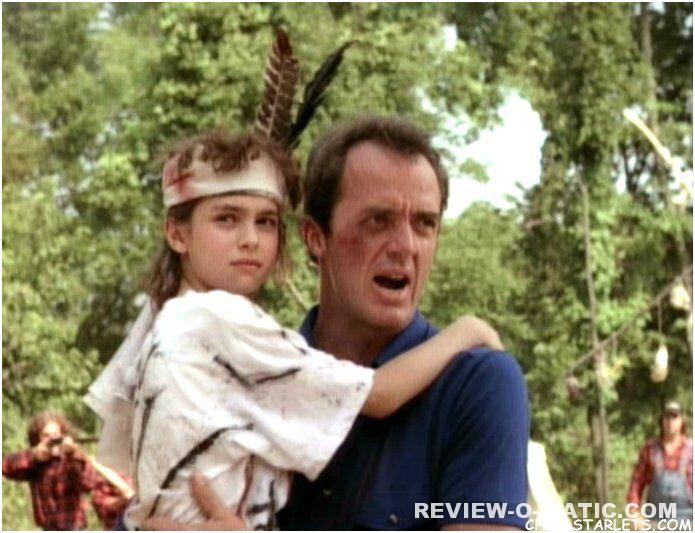
Beware! opens with Professor Randall and his son Glenn camping in the woods. (A lack of acting skill runs in the family.) Other than dad’s penchant for singing songs about mythological creatures to his son around the campfire, the pair seem relatively normal. The camping trip takes an unexpected turn when dad steps in a bear trap, falls, and hits his head. Unable to free himself from the trap, Glenn is sent back to the campsite for food and water. Dad’s plan is to wait until someone discovers him in the woods, but after three or four days in the trap, dad begins to ramble incoherently about demons and goblins and maggots before eventually succumbing to his wounds. Young Glenn proceeds to do the only rational thing and cuts his father open with a hunting knife before eating his guts.

This is five minutes into the film.

Time passes, and we soon meet happily married John and Julie, and their cute daughter Kara. The nicest family in the world is on their way to Uncle Ross’s house. During their trip, the family stops to assist a travelling salesman whose car has broken down. While John looks at his car, the salesman, through ten solid minutes of exposition, explains that the nearby townsfolk are inbred, and that at least a dozen kids have recently come up missing. Once the exposition ends, John fixes the car and his family drives away. Moments later, “someone” murders the travelling salesman by cutting him in half. “Travelling salesmen” belong to a demographic you can still safely kill in a horror movie without too many complaints.

When John and his family arrive at Uncle Ross’s house, they discover Ross’s daughter Amy is one of the teens that has gone missing. This leads to even more boring dialogue, where Ross explains that one local child goes missing every other month. When John (a pulp fiction author) asks Ross why local authorities haven’t looked into the disappearances, we learn that Ross is actually the local sheriff, and is out of ideas. Ross has invited John because he “thinks he might know a mind reader or something.” (Who doesn’t?) During a confusing series of dead end plots, another local, Dr. Fish, arrives and the three men put their heads together in an attempt to solve the disappearances.

When another child goes missing, the sheriff holds a press conference where only one member of the press shows up. With no leads to follow, the three men decide hiring a psychic is their best bet. A psychic is brought in, and our protagonists give her a doll that belonged to one of the children. The psychic follows the doll’s “vibes” into the woods (alone), where she discovers the missing children! This is a happy reunion for ten seconds until the little munchkins begin to jab her in the legs with sharp sticks. Once on the ground, the kids slit her throat and eat her face, while chanting “Gulp the blood, gobble the flesh, tear her to pieces,” over and over.

Meanwhile, Sheriff Ross, John the Author, and Dr. Fish begin receiving push back from the “Brownies” — no, not junior Girl Scouts, but crazy, cult-like locals who live in the woods. The group is referenced roughly twenty times in a two-minute span, so even the densest of viewers know to take note.

The three musketeers of crime fighting go from interview to interview, trying to crack the case. John, who reveals to the group that he believes he has ESP, takes the investigation reigns from the sheriff. While interviewing one crazy local, John spies a car under a tarp. The car belonged to the travelling salesman, and has blood on it.

“What does it all mean?” asks the Sheriff.

“How did you get to be sheriff?” asks the viewers.

At the beginning of the third act, it is not John, but his wife Julie who cracks the case. Julie, a “high school literary teacher,” remembers that the phrase the murderous children were chanting included “alliteration.” She remembers the line came from the ancient story, Beowulf. In Beowulf, the monster, who was also a cannibal, was named Grendel. Remember the cannibalistic kid from the beginning of the film? Glenn Randall? G.Randall? Grendel? Oh boy, this is thin. And I mean, this is the SINGLE CLUE that cracks the case! When the cops look up Professor Randall’s file, they discover “he taught Anglo-Saxon.” Case closed, in my book.

The investigation can’t move fast enough. John’s wife Julie is killed, and Ross’s wife is kidnapped. “And now, it’s personal,” says John, implying that everything up until this point wasn’t personal. John and Ross arrive to confront the children, but the townsfolk have other plans — namely, to violently attack and kill the mob of children on sight.

The race is on. Can John the Psychic Author and Ross the Sheriff find the kids before the angry mob of townsfolk? No. The sheriff’s lawn enforcement background is no match for the dozen children, and he is quickly dispatched. While the children are working on the sheriff, John discovers Amy, hopes in the travelling salesman’s car, and attempts to escape!

(Major spoilers below.)

Grendel, now an older teen, attacks John for attempting to steal his “queen.” John defeats Grendel, and leaves in search of his daughter (who has been kidnapped during the melee). Just as he finds and rescues his own daughter, the townsfolk arrive and attack the children. When John informs the mob that anyone touching one of the children could be charged as “accessories to murder,” he receives a bullet to the forehead. Then, the slaughter begins.

One child is stabbed in the neck with a pitchfork. One gets a hatchet in the back. One takes a meat cleaver to the head. One is crushed with a 2×4. One gets an arrow to the chest. One gets a shotgun to the head at point blank range. One takes a machete to the chest. One has a pistol inserted into his mouth before the trigger is pulled, spraying blood on a piece of wood behind him.

After all the children — their own children — are killed, the townsfolk go home.

The final two minutes of film appear almost as news footage, with still shots of all the dead kids. (Well, not really still shots, most of them are breathing.) At the very end, John’s youngest daughter (who survived the attack by hiding under her father’s dead body) emerges with a knife as she prepares to cut and eat one of the victims. THE END!

Beware! Children at Play isn’t just disturbing — every part of it is awful. I can only assume that this was the first and last acting job for every person appearing in the film. The writing is awful; exposition is presented in huge dialogue dumps, and facts that might seem important (“Oh, I think I’m psychic!”) are buried. There’s no character arc for anyone in the film, no lesson, and no development of any kind. Its only redeeming quality is the shock value that comes from watching it with a friend.

Bedazzled

May 14th, 2009

Isn’t it odd that people in movies never act like people in real life do?

In Bedazzled, Elliot Richards (played by Brendan Fraser) is a geeky tech support employee who runs into Satan HERself (Elizabeth Hurley) at a local club. Elliot only has one wish in life, which is to be united with Allison, the girl of his dreams (Frances O’Connor), but in exchange for his soul, Elliot is granted a total of seven.

None of his wishes are limited in length or stipulation. Elliot is also handed a pager and is told if he dials ‘666’, his wish will be canceled and he will return to our “present” reality. How bad could it get, right?

Pretty bad.

The Devil is not in the business of letting people live happily ever after. Anyone who’s ever seen any of the classic Twilight Zone episodes (The man who was granted immortality gets a life sentence in prison, the man who gets all the books in the world to read breaks his only pair of reading glasses, etc) will know exactly what to expect. The Devil shoots holes in each of Elliot’s wishes by reading between the lines and giving him a little something extra each time.

Elliot’s first wish seemed pretty good to me: he wished to be rich, powerful, good looking, and to be married to Allison. POOF, he gets his wish! Unfortunately, he has become a rich, powerful, good looking COLUMBIAN DRUG LORD, married to an unfaithful Allison. OOPS.

Right about here is where I started getting irked with the movie. In the midst of gunfire, Elliot dials his way out of that wish and, instead of being MORE specific in his following wishes, he becomes LESS specific. Some of his other wishes include stuff like, “I wish I were an NBA basketball player.” Huh? Plenty of room for error there. When Elliot wishes he were the President of the United States of America, the Devil turns him into Abraham Lincoln, about ten minutes before he is shot.

You would think that at some point Elliot would just wish, “I wish my life were just like it is today, except I was happily married to Allison and she were happily married to me. Nothing else would change. Oh, and each time I open my wallet, there would be a new, non-counterfeit, spendable $100 bill there.”

Seems pretty easy to me, but instead Elliot runs around like an idiot wishing he were “the world’s most sensitive man” (who gets beat up by bullies on the beach) and “a well spoken gentleman who the lady’s adore” (they sure do – and so do the men, the Devil made him gay).

Not that I am a big religious person (or a small religious person, for that matter), but I thought I had seen the diety related-cinematic low point when I saw Alanis MOrrisette as God in Dogma. Her casting seems brilliant compared to the gangster in prison who plays God in Bedazzled. If God created us in his/her image, then God looks a lot like Coolio I’m thinking.

I’ve done a lot of rambling about Bedazzled, and not a lot of reviewing, so here’s my short review. Each of the wishes play out like short Saturday Night Live skits – which actually works out okay. None of the skits would make interesting full length movies, but at five to ten minutes each they’re all bearable. The ended totally sucked, and absolutely reeks of “hey guess what this movie is getting to long so let’s end it right now”. Elliot signed a contract thousands of pages long, but happens to wish for “just the right thing” that gets him out of the contract. Likely. This isn’t some sleeze ball attorney here, it’s the DEVIL. HELLO? MR. HORNS??? Pretty easy to fool for being the Prince of Darkness and all that good stuff.

For what it was, Bedazzled is not a bad film. The biggest problem with SNL type films is they take a 5 minute sketch and stretch it into 90 minutes, which almost never works. However, by taking several shorter skits and linking them together, Bedazzled never bores you to death with any one sketch.

If nothing else, the flick is good for sitting around with your buddies and wishing that Elizabeth Hurley will take off her clothes.

PS: There’s an alternate wish that got cut from the film which is hidden on the DVD. In the cut wish Elliot becomes a rock star that seems to be mostly Ozzy Osbourne, with a little Sid Vicious thrown in. There’s plenty of sex, drugs, and rock and roll in this scene, which is why it was cut – to keep the movie at a PG-13 rating instead of a R-Rating, which this scene surely would have done. It’s unfortunate that it was cut, it’s the funniest of the bunch.

PPS: The snake/outfit combo that appears on the cover never appears in the movie.

BBS Documentary

May 14th, 2009

I was ten years old back in 1983, the year my father put his first Bulletin Board System (BBS) online. To this day I can still remember sneaking into the living room in the middle of the night and watching users navigate their way through his menu system. It seemed like magic back then to think that someone sitting in the comfort of his or her own home could connect to our own home computer simply by using a telephone line.

Throughout the 80s and half of the 90s, BBSs were THE place for computer users to meet, talk, and exchange ideas, information, and programs. It was the birth of online culture. Those who didnt call BBSs could never understand the idea of talking to and making friends with people you had never met in real life before. The BBS world had its own culture, customs, and even language. And yet after a run of almost fifteen years, BBSs virtually disappeared overnight, submitting to a new technology — the Internet.

BBS: The Documentary tells the complete story of BBSs, starting with the birth of the first one in 1978 and ending with their demise. If it sounds dry, it isnt; the story is told by people who were there over 200 of them, in fact. For four years, amateur filmmaker Jason Scott traveled thousands of miles interviewing users, SysOps (System Operators, the people who ran BBSs) and many of the movers and shakers of the BBS scene. The material was then grouped by subject and divided up into eight separate episodes, all of which are included in the three-disc set.

Each of the eight episodes average forty minutes in length. As you make your way through the episodes, youll quickly notice that the documentary focuses on people over technical details. As the details of the first BBS are unveiled, youll get to meet the people who created it, and the circumstances surrounding the event. And for the technical historians out there, the segment ends with the inventor of the first BBS digging it out of the back of his closet and showing it to the camera. In fact, many of the people appearing throughout the DVDs are a virtual whos who of computer history. Its literally thrilling to see peoples names pop up as theyre speaking. As one man speaks, a title slowly appears at the bottom of the screen. Vinton Cert, Co-Creator of TCP/IP. Vintage computer fans will recognize many of the interviewees contained within: creator of Punter protocol Steve Punter, infamous hacker Cheshire Catalyst, several members of the counter-culture group The Cult of the Dead Cow, Atari collector and historian Curt Vendel, and dozens more. While not all of the people interviewed are famous, they all have interesting stories to tell.

The discs and episodes follow a logical chronological progression. The first disc contains two programs: Baud, which chronicles the beginning of the BBS, and Sysops and Users, featuring stories from both points of view. The second and third discs contain three episodes each. Disc two contains Make It Pay (the rise of the BBS industry), FidoNet (the BBS Network that Changed Everything) and Artscene (the history of the BBS art world, with interviews from several members of Ice, Acid, and Titan). Disc three consists of HPAC (the world of Hacking/Phreaking/Anarchy/Cracking boards), No Carrier (the end of the BBS) and Compression (the ARC-ZIP battle). Watching all three discs in one setting is probably too much for even the most hardcore hacker. Fortunately, each episode stands on its own so they set can be watched at your own pace.

In addition to the five and a half hours of episodes, there are an additional 80 minutes of bonus footage sprinkled across the discs. Most of these clips are short anecdotes that would of slowed the pace of the documentary, but were still good enough to include and are enjoyable to click through. The third disc of the set is also a DVD-Rom disc which, along with the episodes mentioned, also contains thousands of photos taken throughout the authors journeys, and a few audio speeches in MP3 format.

If you spent any amount of your youth calling BBSs, these DVDs will instantly take you back 20 years. I heard so many stories that I could relate to during these episodes that it was almost like sitting around a campfire, listening to old friends share stories about the good old days. Jason Scott has done a superb job of capturing the passion and excitement of the BBS era and presenting that to viewers. BBS: The Documentary is both informative and entertaining. Those who were there will watch the episodes constantly grinning and nodding, while those who werent will listen to the stories in awe. My wife, who is decidedly non-technical, enjoyed the documentary almost as much as I did. At one point during the program, she turned to me and said, Who knew there were people out there just like you? Highly recommended to everyone even remotely interested in computers and technology.

Originally submitted to TheLogBook.com

Barstool Cowboy

May 14th, 2009

Barstool Cowboy opens with a monologue from our titular cowboy (Mick, played by Tim Woodward), explaining to us that he’s just been dumped. One of the reasons his ex gave for dumping him was that he spent too much time “hiding behind his beard,” so with some advice from fellow bar patrons, he shaves it off. Mick swears to avoid women and remain loyal only to his barstool for three solid months, but his vow lasts less than a day.

Less than twenty-four hours into his vow he meets Arcy (Rachel Lien), a nineteen-year-old art college student who, by chance, ends up outside Mick’s watering hole of choice. When Mick goes outside to see what Arcy (channeling Avril Lavigne) is up to, the two make a connection. At that point Mick leads her back into bar and begins buying drinks for his new underage friend.

For the next hour we get to watch this whirlwind romance develop. Arcy is attracted to Mick’s lifestyle. She wants to “follow him around all day long,” just to see what he does. Mick is attracted to Arcy because, well, she’s a hot college girl twenty-five years his junior who wants to hang out with him. Although the age different between the two is pointed out within the film (Arcy admits that she “doesn’t know who Mick Jagger is”), no one else within the confines of the film seem to think it’s weird not even the regulars at the local country and western bar, where Mick takes Arcy dancing.

The biggest problem with Barstool Cowboy is the lack of character development. On one hand you’ve got Mick, an unemployed “cowboy” whose lack of income doesn’t prevent him from renting a motel for a few days, paying $160 cash for three bottles of wine, or hanging out at the bar drinking for months at a time. On the other hand we have Arcy, who is either the world’s most adventurous college freshman or the dumbest. Within a few hours of meeting Mick, nineteen-year-old Arcy is skipping school, drinking beer, smoking dope, and sleeping in Mick’s bed (in that non-sexual way that Michael Jackson sleeps with children in the same bed). The relationship develops so fast in fact, that Arcy trusts Mick enough to sleep in his hotel room, and Mick trusts Arcy enough to leave her alone in his apartment. Boy have I been hanging out at the wrong bars! The biggest stumbling block is that we’re kind of left wondering why these two would want to spend more than five minutes in one another’s company, especially given the film’s ending.

Throughout its 90 minute running time, Barstool Cowboy actually gets quite a bit right. The story, such as it is, is well told. Many of the camera shots are imaginative and nicely framed. Throughout the story, we get glimpses of how Mick and Arcy can help one another grow (for example, Arcy expands Mick’s horizons by taking him to an Indian restaurant for dinner). For an indie film, Barstool Cowboy’s soundtrack is terrific. Many of the film’s songs are tightly woven into the film and are used to directly convey information to the audience.

Writer/director/producer Mark Thimijan’s Barstool Cowboy is a little rough around the edges but definitely worth catching, especially if you’ve ever sat at a barstool trying to forget about a woman.

I’ll drink to that.

On the web: http://www.barstoolcowboymovie.com

Barbarian Queen I / II

May 14th, 2009

Last week I walked into a thrift store looking for some old computer parts and walked out with two new DVDs for my collection: Barbarian Queen, and Barbarian Queen II. I’ve never heard of these movies, none of my friends have ever heard of these movies … in fact, there’s only one reason I now own both of these barbarian chick flicks — $2.98 each, baby.

Each movie is wrapped in those classic fantasy-style paintings, with female barbarians swinging swords, posing in g-strings, and flexing muscles. The discs don’t contain many (read: any, other than trailers) extras, but then again, with almost three hours of barbarian dominatrixes roaming the Earth, who needs a commentary track?

Barbarian Queen begins with the destruction of Amathea’s village — on her wedding day, no less. The evil king’s soldiers capture prince Argan and take him back to their castle. We all know that nothing pisses of a woman more than fucking up her wedding plans, and before long Amathea has teamed up with three other surviving amazon hoochies and devises a plan to rescue Argan and kill the evil king. Armed with swords, horses, lip gloss, hair curlers, eye shadow, and some skimpy barbarian threads, princess Ho-Nan the Barbarian (as my wife dubbed her) and her entourage gallup into the forest to overthrow enemies at large.

By “her entourage”, of course I mean “all of their boobies”, which you get to see throughout the movie. Whether it’s being raped, being attacked, being tortured, or just being stripped, all four barbarian women manage to show their jigglies on screen at least once throughout various points of the movie.

If you’ve ever played Dungeons and Dragons, you will giggle and sigh at the movie’s dialogue. “I’ll be no man’s slave and no man’s whore, and if I can’t kill them all, by the gods they’ll know I’ve tried.” If that line wasn’t dreamt up over a bag of Cheetos and one too many swigs of Dr. Peppers straight from the 2 liter bottle in the middle of an all-night D&D session, I don’t know what was. Wait, sure I do — the rest of the movie’s lines are just as bad.

Do you really want to know the plot? Chicks run around, losing their tops and although occasionally they overpower the manly guards, usually they just end up in whipping racks — topless again, of course. Everything you could ever want to see in a female barbarian movie shows up in Barbarian Queen — which makes the release of Barbarian Queen II even stranger.

Barbarian Queen II has about as much to do with the first film as Halloween III has to do with the rest of the Halloween series. Lana Clarkson reprises her role as Amathea in name only. Instead of an almost-married princess, in #2 Amathea is a noblewoman. After a run in with her brother in which he steals the crown, we soon find the barbarian queen back in the forest, once again rounding up fellow female barbarians in order to restore order to the throne and … yadda yadda yadda.

After some friendly topless mud wrestling, the barbarian queen and her female barbarian followers once again storm the castle. Just like the first movie, things don’t go well, and soon we’re right back to the barbarian queen being captured, tied up, and whipped — you’d almost think she liked it by now.

During their journey to right the wrongs of the world, the girls tops all end up off again somehow. Amathea finds a “sceptre of power” which made me giggle even more with all the other sexual jokes going on, but she is captured and returned to the rack and sentenced to death by torture. Whee! Eventually a knight comes into play and Amathea and the knight head back to the castle to fight evil one last time (this time with her top on … for a while, at least).

Barbarian Queen and Barbarian Queen II aren’t the worst movies I’ve ever seen. In fact, they aren’t even the worst movies I’ve seen this week. But they are pretty bad. If hoochie barbarian women galluping around the country side constantly losing their tops and fighting for what’s right while mumbling poorly written D&D influenced dialogue is your cup of tea (and you happen to run across these movies for $2.98 each), then pick them up I say. If Conan seemed cheezy to you, the Barbarian Queen duo are a big order of steamy nachos with double queso.

Update: Lana Clarkson, the star of Barbarian Queen I and II, was found dead at Phil Spector’s house in February of 2003. I’ve since sold these DVDs on eBay and made a “killer” (ahem) profit. Thanks, Phil!

Backyard Wrestling – Kings of the Ring

May 14th, 2009

Backyard Wrestling. You’ve seen the commercials — teenage males punching, kicking, smacking, smashing, flopping, throwing, jumping, flying, falling, burning, cutting, and occasionally, wrestling each other. These tapes are the fuel that parents, teachers, lawyers and churches use as evidence for the eternal “kids will imitate what they see on television” debate. Are these videos as extreme as the commercials make them out to be, or is it all just a bunch of hype? Read on to find out!

The Best of Backyard Wrestling begins with a stunt gone wrong. A kid, standing in the middle of the street, prepares to get “run over” by a car, driven by one of his “friends”. For the record, this video will certainly make you reevaluate your definition of the word “friends”, because MY “friends” don’t go around trying to hurt me, even when I probably deserve it. The car accellerates a little too fast, and the kid standing in the street goes from standing to airborn to windshield to ground in about two seconds. If this sounds shocking, you ain’t seen nothing yet.

The next ten minutes of the video are a montage of what’s to come — mainly, lots of kids walking around, smacking each other with trash cans and bleeding a lot. There are shots of people jumping off roofs, breaking tables, and setting each other on fire. Video quality is what you would expect, and often worse. None of these guys are hiring film crews, this is all teenagers running around with camcorders trying their damnedest to capture the action.

During the opening footage you get to see a lot of different wrestling “rings” used in backyard wrestling. Rings, in backyard wrestling, include everything from actual wrestling/boxing rings in high school gyms, to backyards with (or without) ring ropes, trampolines, dirt, grass, or concrete. You name it, people probably get hurt on it on this video. Most of the rings have houses, trees, cars, streets, BBQ grills, lakes, streams, or other urban obstacles in the backyard. Crowds for the matches range anywhere from a dozen or so people to just the participants themselves. Occasionally, you’ll catch an observer walking or driving by, craning their head around and wondering what the hell all these kids are doing with light bulbs, tables, and fire …

The main film has some loose categories in which the film clips are divided up into. These categories include …

Light My Fire: Yes, just tons of footage of kids setting each other on fire. What kills me is the total lack of preperation these kids take. For example, in one shot, kids set a 4×8 sheet of plywood on fire, and then powerbomb a kid through the table. Of course, the flimsy wood breaks in half, and now the kid is basically engulfed in a flaming wood sandwich. He then starts freaking out, while all the other kids stand around with a “wow, we didn’t expect him to catch on fire!” look on their faces. After ripping off layers of clothes, the kid eventually rolls around enough to extinguish the flames. In clip after clip, kids set each other on fire and then act surprised to discover that (a) fire burns (b) burning hurts (c) things on fire continue to burn until you put them out (d) now is too late to think about fire extinguishers, water or blankets. Go figure.

Choose Your Weapon: You don’t think fists and boots are enough, do ya? This segment of the video has clips of kids getting pounded by golf clubs, tables, mallets, hammers, propane tanks, regular shovels, snow shovels, crutches, ladders, bicycles, guitars, cars, any type of scrap wood you can imagine, bales of hay, sheetrock, and of course, the obligatory trash cans (metal or plastic, your choice).

Groin Pains: Bob Saget and the rest of the crew at America’s Funniest Home Videos discovered this formula years ago — crotch shots are funny. Whether they’re being kicked, punched, smashed, stomped on or landed on, everyone likes to see gonad contact. There’s no shortage of these clips here. If ball-bashing is your thing, you’ll love this segment.

Have A Seat: This portion of the video contains clips of people getting hit with metal chairs. Unfortunately the kids in the video haven’t seemed to learned the exact techniques that the pro’s use, and consequently, lots of kids get hurt in this portion. Wheeeeeeee!

Three other sections include The Pain Game, a collection of clips of kids getting hurt, Cops In The Backyard, which is just one clip of some backyard wrestlers apparently getting arrested in a park, and Quick Chick Flick which has two or three random clips of some girls getting (slightly) involved in matches, and then one bikini match of a couple of girls in an inflatable pool. Forgettable.

The video also contains The Epic Battle, which is more memorable for it’s length than the actual wrestling. The match takes place in a parking lot. And on some stairs. And inside a school. And in the hallways. And in the gym. And in the locker room. And in a bathroom. And outside near a car. And on top of that same car. And on top of the car while it’s driving away. Finally, after a pile driver on top of the car’s hood, one wrestler finally pins the other.

The Best Of BackYard Wrestling on DVD not only contains the above program, but also Backyard Wrestling Babes and some Extra Features. The extra features include:

The Backyard Babes, Backyard Blunders, Sneak Preview, Forbidden Bonus Footage, Dungeon Deathmatch, Special Offer, and a special hidden area (whee). The Backyard Babes section contains short (like half a second) clips of the girls in the video (brief boobage nudity). Tylene Buck is pretty hot, but be prepared to use your pause button. The Sneak Preview contains trailers for their full length Backyard Wrestling Babes video, as well as a trailer for Backyard Wrestling II. The Special Offer is an address that you can send your name into a win a free copy of the video (you’re already watching it — why would you want it againf or free?). The hidden trash can icon is about ten seconds of a match where a guy loses his cool. That leaves us with Backyard Blunders, Forbidden Bonus Footage, and the Dungeon Deathmatch.

Backyard Blunders: This section contains three short clips which were also in the main video program. The majority of these clips contain things like tables not breaking, tables falling apart, people falling/missing their mark, a dog chasing the wrestlers in a dude’s backyard, things not breaking on cue, people falling off ladders, etc.

Forbidden Bonus Footage: This section contains three matches that were left off the video because they were too “graphic”. Match one mainly contains some kids using barbed wire. The second match contains more kids using barbed wire, but they’ve added light bulbs to the mix. Match three (which takes place in a driveway) adds chairs and trashcans to the mix. All of these get a little bloody.

Dungeon Deathmatch: This is the oddest clip of the whole video, in my opinion. Two wrestlers square off in one of their basements, and the violence is on! Busted lightbulbs and barbed wire are just the beginning. Eventually the two empty big bags of thumb tacks on the floor and suplex each other into the pile, with dozens of tacks stuck in their back and to their heads. One of their weirdest things about this match is, no one is watching. The only people present are the two wrestlers, and the cameraman.

The end of this video dedicates itself to all the “Blood, Sweat, and Chairs” poured into these video clips — and I’m guessing that plenty of all three went into the filming of this video. It’s a shame that the wrestlers basically get squat for their submissions and the company that puts this video out is getting rich off it, but hey that’s life I suppose. The president of Backyard Wrestling, Inc is probably driving a new Porsche off the sales of this video, while the wrestlers contained on this video are holding up a gold-painted hubcap with two straps hanging off it, pretending it’s “the championship belt”. I don’t know if these wrestlers will ever get the notice or reward they deserve. I don’t know if one of these guys will go on to become the next Mick Foley or the next hardcore champion, but I do know they’re working their asses off in backyards beating the hell out of each other, and this video opens a small window into that world.

Aristocrats, The

May 14th, 2009

The Aristocrats is an hour and a half long documentary about a single, filthy joke, one you probably haven’t heard and is most commonly told between commedians and other comedic insiders. Throughout the course of the film over a hundred of Hollywood’s most famous comedians tell the joke and talk about the history of the joke, where they first heard it and who they first heard tell it.

The joke on which the film is based on isn’t really that funny, but of course that’s not really the point of the film as even the world’s funniest joke would get old after hearing it a hundred times in a row. The joke is somewhat unique in design in that it allows for the performer to put his or her own personal spin on the joke — it’s compared to a jazz riff within the film. The joke starts and ends the same way each time, but the middle portion is always unique, and that’s part of what makes the film fun to watch. You’ll see everyone from Drew Carey to Andy Dick, Whoopi Goldberg, Jackie Martling, Howie Mandell and George Carlin and dozens more tell their versions of the joke.

More interesting than the joke itself is the way each performer crafts it into their own. The goal of the joke is to make the middle portion of it as vile and repulsive as possible — no bodily fluid or sexual act between family members (including the family pet) is off limit. Each time you think the joke cannot get any worse, it will, and those of you who only know Bob Saget from his work on America’s Funniest Home Videos and Full House will get a brief glimpse into his demented sense of humor.

The extras on The Aristocrats DVD are longer than the film itself, including even more footage of comics telling and retelling the joke, along with some of their other favorite jokes, cut footage, and more. Also included is a commentary track by directors Paul Provenza and Penn Jillette (of Penn and Teller), which was quite informative and as rapid fire as the film itself. The commentary track justifies the appearance of each person in the film (some of which weren’t obvious to me) and clears up a a few parts that while maybe obvious to comedic insiders seemed a bit confusing to us movie-watching laymen.

Fans of comedy will enjoy this look into what makes commedians laugh. Definitely worth a watch for all fans of the art and craft of comedy. Those offended by descriptions of deviant sexual acts should steer far, far away.

April Fool’s Day

May 14th, 2009

April Fool’s Day is a classic horror film from the Golden Age of Slashers. Released in 1986, April Fool’s Day follows the routine formula that was popularized by Friday the 13th and duplicated hundreds of times throughout the decade: teens congregate, teens party, teens start getting killed, remaining teens try to escape and/or solve the murder before they’re next. And for most of them, they’re next.

In April Fool’s Day we meet Muffy, a popular high school senior who’s throwing a spring break party at her parents’ home located on an island. Her party loving friends arrive on the island by ferry on Friday, and are stuck there until the ferry returns for them Monday morning. When one of the teens goes missing and his body is spotted floating in the water, the rest of the partiers think a terrible accident must’ve occurred; shortly thereafter when they discover his severed head in a sack, they correctly deduce that his death was not an accident. Now it’s up to the teens to do their best to survive their weekend on the island. Some teens are luckier than others. Who survives is a surprise, and Muffy will ultimately deliver the biggest surprise of all.

April Fool’s Day builds to a plot twist that few people see coming and concludes with a final “gotcha” not unlike the final scene from the original Friday the 13th. This film will keep you on your toes. It’s a good slasher flick that I always liked, and I enjoyed going back and watching it again this week. It had been so long that I had forgotten many of the movie’s details, and I enjoyed it all over again. As a slasher film it follows the rules of the genre, and still manages to add something relatively new to it. (It’s not a completely new idea; the film borrows plot ideas from films like Murder by Death and And Then There Were None.) Still, it’s well done and has slightly more depth than many similar films.

YourBell (mp3 doorbell)

May 14th, 2009

What do you get the guy who has everything? This is a problem my father and I run into buying gifts for each other every year. While neither of us are rolling in cash, we both have a tendency to buy the things we want, leaving few gift ideas for each other when holidays roll around. The end result is, we often end up buying each other really unique gifts. For my birthday this year, dad bought me a YourBell. One thing I can definitely say is … I definitely didn’t have one already!

The YourBell, from BCS Ideas, is a replacement doorbell that plays MP3s (or WAV files) whenever someone rings your doorbell. YourBell retails for less than $100, comes in a variety of woods and stains, and easily connects to your pre-existing wiring.

Connecting the YourBell couldn’t be simpler. If you already have at least three wires going to your current door chime, you’ll be in business. Wiring diagrams and examples for almost any type of installation are included on the packaged CD. And, if you run into any kind of weird wiring issues (like I did), simply e-mail the company’s support e-mail address (again, locaed on the CD as well as the BCS website). Within 24 hours (over a holiday weekend) I received a response, more documentation, and the engineer’s home phone number if I needed more support. Talk about service!

Sound files are loaded onto the YourBell using an included program and USB cable. The software defaults into a wizard mode that walks you through the four or so steps to loading sounds on to your YourBell. If you load more than one sound, the YourBell will cycle through them one at a time. The documentation says that the YourBell holds “about four minutes worth of music.” The CD also contains freeware audio editing tools and a CD ripper, but I can’t imagine anyone buying an MP3-playing doorbell who doesn’t already own such programs. The installtion of the tools is optional so I’m not complaining.

The wiring from your wall connects to a small plug which itself plugs into the YourBell. The YourBell hangs on the wall like a picture frame, so removing it is a simple matter of disconnecting the rear plug and removing it from the wall. If you’re like me you’ll probably be reflashing songs on the thing on a weekly basis, so its nice to be able to easily remove the unit from the wall.

For our test run, my son chose Ghostbusters as our doorbell. Minutes later, cooler heads prevailed — now the unit blares the chorus from Michael Jackson’s “Beat It” whenever someone rings our bell. Runners up included Men At Work’s “Who Can It Be Now?”, Guns and Roses’ “Knockin’ on Heaven’s Door,” and that annoying disco song, “Knock on Wood.”

So for that technology-lovin’ guy in your life who has everything (or for yourself!), I highly recommend the YourBell. Great concept, great product, great technical support. And I guarantee the person you’re about to buy one for doesn’t have one already.

Link: http://bcsideas.com/yourbell.htm