Sculpting the Galaxy by Lorne Peterson (2006)

November 12th, 2013
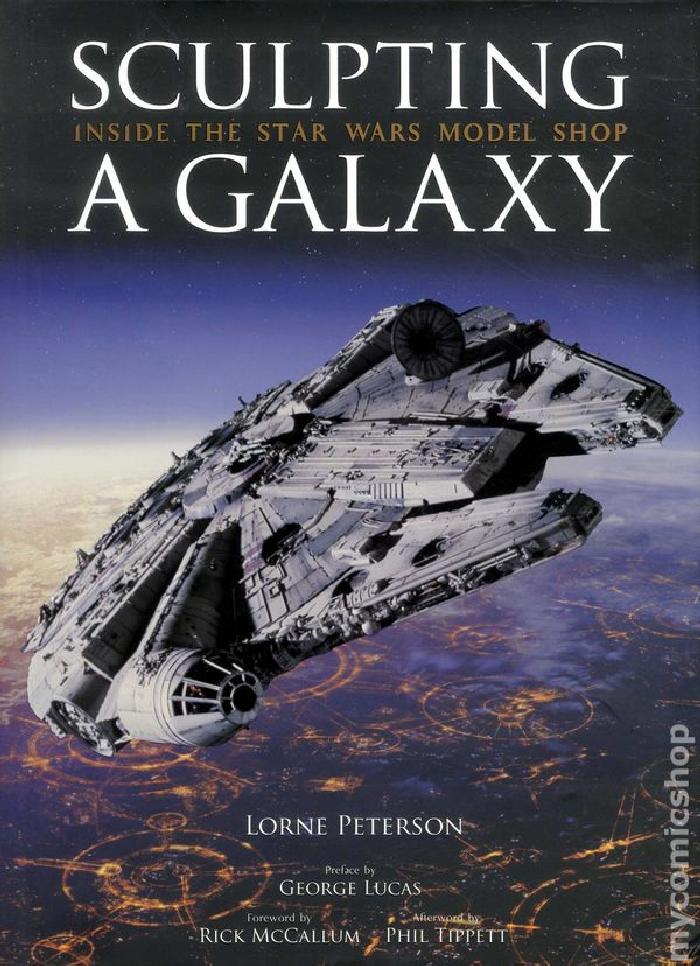
There’s something about physical miniature models that CGI, at least currently, cannot seem to capture. There’s no doubt that computer graphics have opened up new world (both figuratively and literally) to filmmakers, but the way a physical model photographs on screen just has a feel to it that computers can’t always seem to duplicate.

In Sculpting the Galaxy, physical models are the stars. With a preface by George Lucas, a foreward by Rick McCallum and an afterward by Phil Tippett there’s plenty to read here, but the focus of this book are the models themselves. While browsing through my local Half Price Books I spotted this book and randomly flipped it open to this picture:

Sold.

The book is divided into four chapters that serve as categories: Starships, Vehicles, Droids and Creatures, and Environments. Each section contains dozens of models and is roughly chronological as it moves from the original films to the prequels. Whether you were hoping to see detailed pictures of original TIE Fighters or details from Queen Amidala’s palace, you’ll find them here.

Huge advances in technology were made between the time the two trilogies, so while the original trilogy is represented solidly by an army of models, most of the prequels are represented by models that were later scanned and turned into three-dimensional computer models. It will always be more interesting to me to see the actual figures used in the hologram chess game on the Millennium Falcon as opposed to a carving of Watto that was eventually digitized into a CGI character.

The text accompanying the pictures is informative. Much of it is common knowledge to fans of the films, but even I picked up a few new nuggets of trivia along the way. I did not know that the original Death Star model was accidentally thrown away after filming, for example. Another thing I did not realize was just how many of the sets that appeared in the films were actually miniatures. Even a CGI podracer apparently looks better on screen when filmed against a physical set, even if the set is tiny.

My only real complaint about this book is that occasionally the text is difficult to read. On many pages, the headlines and captions are printed in a bronze, almost dark brown color on a black background. On other pages, white text appears on black, starry backdrops. More than half of the pages contain small, white text on black backgrounds. If you’re old enough to remember seeing the original trilogy in theaters a long, long time ago, forget your trusty blaster and bring your reading glasses to this battle instead.

Between Star Wars in Concert, Star Wars: Where Science Meets Imagination, and a few trips to museums, I’ve seen authentic Star Wars models half a dozen times. Unfortunately due to age they’re always behind glass. Sculpting the Galaxy is a great way to see them up close and marvel at the details that went into making ships we’ve been in love with for 30 years now.

iOS: Downcast

December 5th, 2012

While I have phone apps on the brain, I decided to bang out a quick note about Downcast. Downcast is a podcast management tool for iOS (iPhones, iPods, and iPads). Unlike Any.do it’s not free, but if you own an iOS device and are even remotely into listening to podcasts, you should buy this app.

Downcast is a complete podcast management tool that operates independently of iTunes. If you’re like me and rarely (if at all) use iTunes, Downcast is a lifesaver. By entering in the iTunes or RSS feeds of your favorite podcasts, Downcast will (when launched) automatically download the latest episodes. Among other options, you can configure how many episodes of each podcast you with the app to download and/or save. I have mine to save the five latest episodes of each one on my phone. If you want to listen to older episodes that are no longer on your phone, or brand new episodes that you haven’t downloaded yet, Downcast supports streaming.

Downcast has a built in search feature that links to the iTunes podcast category. You can search by title or genre or keyword and find podcasts to listen to. The app handles both audio and video podcasts, and also supports simply listening to the audio of video podcasts if bandwidth is an issue.

Where Downcast absolutely excels is in its settings. You can set the app to only download when connected to wi-fi, to take it easy on your data plan. You can schedule when you want the app to check for updates by time or location. You can configure it to retain a set number of podcasts, or a set number of unlistened to podcasts. You can set up playlists. You can set it to play back audio at a higher rate of speed. One feature I love is, if you use iCloud, you can configure the app to share your podcast lists with other iOS devices — that means the podcasts I subscribe to on my phone will also appear on my iPad. Too cool.

Downcast costs $1.99 in the App Store and is worth 10x that to anyone on the go who likes listening to podcasts.

iOS: Any.do

December 4th, 2012

I use my smartphone all the time for sending and receiving e-mail, engaging in social media, playing games — oh, and occasionally making phone calls! Lately I’ve been looking at some productivity apps to help me with various tasks. A lot of times these apps get installed and removed within a matter of hours after discovering that they either (a) don’t work as advertised, or (b) I simply don’t use them. The ones I find myself using for more than a week, I typically keep. One I’ve been using for over a month now is Any.do.

Any.do is a simple task management application that allows you to schedule and juggle tasks.

The first thing you’ll notice is that instead of using a calendar, the app’s default view displays four folders: Today, Tomorrow, This Week, and Later. This makes so much more sense to me. Let’s say I need to wrap some Christmas gifts. I can add myself a note to do it tomorrow. Tomorrow, that task gets moved to Today, and the app will remind me to do it. Cool! As tasks are completed you can draw a line through them with your finger. Tasks can also easily be reordered or moved to different folders by dropping and dragging them with your finger.

Another cool feature of the app is that it can sync with other phones. If you use Google Chrome, you can install a Google Chrome app and sync with it, too. By using the Google app, if I’m sitting at my computer and think of something I need to do tomorrow, I can add it to the app and it’ll sync to my phone. More typically though, I think of things I need to do tomorrow or next week while driving, or watching television, or sitting at my desk at work. In those cases I simply add the tasks to the phone. If I need to re-prioritize them later, I can do do. Any.do is promising a web version of their app is “coming soon.”

Any.do offers Facebook and Twitter integration as well, features I don’t use. I don’t need my phone sending out tweets or posting to my timeline every time I mail out a package or wash the car. Any.do can also access your contact info (if you let it), if you want to add tasks that involve other people. I always freak out when apps ask for access to anything extra so I initially denied it, but later recanted and granted it.

Did I mention Any.do is free? Any.do is free. Free for the iPhone, free for Android, and free for Chrome. I don’t know if the web version will be free or not, but I assume it will be. I have no idea how the creators of Any.do make money or how they plan to make money.

Any.do has been panned by some who say that it doesn’t have enough features. For me, that’s exactly the beauty of it — Today, Tomorrow, Next Week, Later. It’s very simple to install and begin using. And, it’s free.

MindCandy Volume 3: Demos 2003-2010 (2011)

February 6th, 2012

It’s not fair.

After spending several hours watching MindCandy Volume 3: PC Demos 2003-2010, I decided it’s simply not fair that there are people on this planet talented enough to create art this visually stunning, using the exact same ones and zeros that all of us have access to, on computers no more powerful than the one you’re reading this review on. It’s unbelievable, is what it is. Unbelievable, and unfair.

Back with a third package of computer demos is MindCandy Volume 3: PC Demos from 2003-2010. The original MindCandy release contained both older and modern PC demos up to the disc’s release date (2003). Volume Two contained demos programmed on the Commodore Amiga. Many fans of the series (myself included) assumed that the third volume would cover Commodore 64 demos; however, the folks behind MindCandy explain in one of the package’s many extra features that several DVDs of C64 demos have already been released, so instead the group decided to refocus their energy elsewhere.

The result is MindCandy 3, a visually amazing collection of forty PC computer demos released since 2003 — and when I say visually amazing, I truly mean it. I watched the Blu-Ray version on a high definition television and the demos were absolutely stunning. Whether you are looking at abstract shapes and colors or watching virtual worlds unfold before your eyes, you will continually be in awe. In one of the included bonus features, Jim “Trixer” Leonard gives advanced technical details about how the video were captured. This particular feature reveals not only the technical expertise of the people behind the series, but also the amount of care that went into preserving the accuracy of each video.

httpv://www.youtube.com/watch?v=uEB5yywLmOY

The video quality presented on MindCandy 3 is top notch. Don’t let the 720p number fool you; running at 60 frames per second, these demos are gorgeous. With bright colors, fluid motion and no artifacting, the demos look as good if not better than they would on your computer. If I were trying to sell my HD television, this is what I would have running on it.

Audio on the disc is presented in a Dolby Digital 2.0 mix. While some other online reviews dinged the package for not including a 5.1 surround sound mix, I did not feel the two-channel stereo mix detracted from the experience at all. While I believe a lack of free space on the discs was part of the reason for not including a 5.1 mix (the Blu-ray version takes up around 46 of the 50 available gigs worth of space), I believe that most (if not all) of these demos were originally released in stereo format. Given all the work the group did in preserving the video quality of the original demos, including an artificially mixed surround sound track seems (to me) to miss the point. Even with the 2.0 mix, my home theater had no problem blasting out the electronically crafted demo tunes.

One of my favorite MindCandy features, the audio commentaries, has returned again in Volume 3. Where possible, the creators of each demo have gathered and recorded audio commentaries specifically for MindCandy. Some of them are silly, some of them are technical and dry, and some of them are downright bizarre, but all of them are worth listening to. If you’re the type of person that enjoys Pop-Up Video and listening to DVD commentary tracks, you’ll find the commentary tracks both interesting and entertaining. I found hearing why programmers made some of the choices they did was fascinating and made the experience that much more enjoyable. Each audio track also contains subtitles that can be enabled or disabled regardless of which audio track you have playing (which would allow you to listen to the original audio track with the commentary subtitles displayed on screen, for example).

While watching the included videos from disc, it’s easy to forget that these demos run and generate all the video and graphics you’re see in real time on a PC. When my wife mentioned that some of the graphics “weren’t quite up to Pixar standards,” I reminded her that CGI movies are pre-rendered. According to a recent Gizmondo article, Pixar’s Cars 2 used a rendering farm containing 12,500 CPU cores and each frame took approximately 11.5 hours to render (Link). The demos contained on this disc can be downloaded and run on a run-of-the-mill PC.

Which leads to what for some may be the elephant in the room: why pay for a DVD or Blu-ray disc full of demos that are freely downloadable from the Internet? Personally I can think of several reasons.

– The A/V setup in my living room far exceeds the one in my computer room. My PC’s 24″ monitor and small speakers don’t compare to my 55″ HD television connected to a surround sound receiver. These demos may have been designed on the small screen, but look fantastic on big ones.

– No hassle. I want to watch these demos, not download each one and hope that my under-powered laptop will display them properly. MindCandy 3 costs less than the video card I would probably need to view all of these demos at 60 frames per second in 720p.

– The Commentary Tracks. For me, these alone are worth the price of admission. Having someone explain the idea behind each demo was awesome.

– The Extras. The Blu-ray edition of MindCandy 3 contains several additional extras, including a section of 64k demos (demos written in 64 kilobytes or less), 7 hours of demoscene-related speeches recorded at NVScene, the aforementioned Production Notes, and some footage from RVScene. Both the Blu-ray and DVD versions of MindCandy include the audio commentary tracks and subtitles.

For anyone remotely interested in the computer demo scene or computer programming, at $20, MindCandy Volume 3 is an absolute steal. If you include all the commentary tracks and extras, that’s less than a dollar an hour.

Purchase Link: MindCandyDVD.com

See Also: Review of MindCandy 1 and 2

Dio – Evil or Divine

December 30th, 2011

Ronnie James Dio fans aren’t getting any younger. To save nursing homes the trouble and expense of loading up all the old people into wheelchairs, loading them up into the retirement wagon and dragging their wrinkled hineys to the nearest concert venue. Dio has released Evil or Divine on DVD, a live concert from 2002.

Aw, c’mon. We kid because we love. I hope to be in the shape Ronnie James is in when I’m his age, which is basically impossible, seeing as though he’s 30+ years older than me, and already in better shape than I am. The 100 minute long DVD features Ronnie James in top form — running, performing, and of course, singing, without ever missing a beat. It’s guys like this that make Axl Rose’s and Rob Zombie’s live vocal performances seem embarassing.

Of course, Dio OUGHT to be good at this — he’s been doing it for a long, long time. From Rainbow, to Black Sabbath, to his incredible solo career, Dio has been rocking longer than most nu-metal band members have been alive. And in Evil or Divine, he gives them a history lesson.

The moment you see the track names “drum solo” and “guitar solo”, you know you’re going to be treated to a classic-style metal show, and Dio delivers. With material spanning his entire career, Dio delivers on such hits as “Rainbow in the Dark”, “Holy Diver”, and “Man on the Silver Mountain”. Dio also treats viewers with tracks from his latest release, Killing the Dragon.

The DVD delivers beautiful audio. With dolby digital, 5.1, and DTS tracks to choose from, this disc is guaranteed to blow your speakers wide open. Unfortunately, the video quality isn’t quite as good — it’s pretty grainy, and looks it was either blown up or highly compressed. Either way, once the music kicks in you really won’t care.

Beside the concert footage, the DVD also contains an interview, some behind the scenes footage, a photo gallery, and a music video (“Push”).

I’ve started collecting these DVDs for my son. He’s two years old, but I’m convinced when he gets older all that will be left on MTV and the radio will be boy bands, teenage girls singing computer-generated hits, and lots and lots of rap. And when he’s older, he’ll ask me about “the good ol days.” And when he does, I’ll put this DVD on and we’ll rock out together. And then he’ll ask me if he can cut his mullet and I’ll say no.

01. Killing the Dragon
02. Egypt/Children of the Sea
03. Push
04. Drum Solo
05. Stand Up and Shout
06. Rock and Roll
07. Dont Talk to Strangers
08. Man on the Silver Mountain
09. Guitar Solo
10. Long Live Rock and Roll
11. Lord of the Last Day
12. Fever Dreams
13. Holy Diver
14. Heaven and Hell
15. The Last in Line
16. Rainbow in the Dark
17. We Rock

Chimaira – Pass Out of Existance

December 30th, 2011

It’s fast, but not too fast. It’s brutal, but not too brutal. It’s heavy, but not too heavy.

Ok, strike that last part. It’s pretty damn heavy.

Hailing from Cleveland, the six members of Chimaira have built a solid fanbase over the past three years. Their hard work and dedication began to pay off after an appearance on Farmclub.com got the ball rolling. Appearances on two compilation albums (ECW’s Anarchy Rocks and a Cure tribute titled Disintegrated) and intense touring got their name out to even more people. Like the mythological creature of the same name (but different spelling), Chimaira lies in the shadows, ready to take over the world.

Their debut album, Pass Out Of Existence, could help them do just that. Pass Out Of Existence contains 14 brutal tracks that I GUARANTEE will put Chimaira on the map. They are the best band of this genre I’ve heard to date.

What genre is that? That’s a question easier to ask than to answer. Rapid blasts of kick drums, futuristic sounding keyboards and an intense vocal presence will almost certainly draw comparisons to Fear Factory. That’s not a bad thing. Where Fear Factory’s songs are either extremely mechanical or extremely non-mechanical, Chimaira mixes the two approaches fluently in each song, presenting a driving yet emotional sonic attack to the listener. Pass Out Of Existence takes the genre further than Fear Factory has over their last five albums. The thought of what Chimaira will be doing five albums from now gives me goosebumps. The dual guitars and keyboards give Chimaira an extra “thickness” that other bands are often missing — and yet, the band is amazingly tight. The band remotely reminds me of early Machinehead and Vision of Disorder, with maybe even a touch of Sepultura, but make no mistake, Chimaira is not a direct copy of anything I’ve ever heard.

This disc contains no filler. Each song is as aggressive and brutal as the last. Although the band has obviously invested a lot of hours into developing it’s own “sound,” each song is unique. Mudrock (producer, Godsmack, Powerman 5000) has done a good job of focusing on the differences between the songs and bringing those slight differences out. While the songs are always changing things up, it’s still straight forward rock – no Meshuggah-like time changes here or anything. Good, good stuff. The only break you’ll get while listening to this album is by using your pause button — from beginning to end, this disc does not let up.

A few months ago I went to an Ill Nino/Factory 81 show, and walked away a Chimaira fan. Ill Nino, Factory 81 and 40 Below Summer all put on good sets that night, but Chimaira totally blew me away. It was very similar to the first time I stood in front of Slayer and watched them play live. Part of me wanted to mosh/jump/hop, but I was too afraid of missing even one drop of their performance. Their live performance sounded great, and the CD sounds even better.

I could spend hours coming up with witty metaphors and beating around the bush, but let me instead use the direct approach: Chimaira has managed to crank out the best album I’ve heard this year. Not since Pantera’s Vulgar Display of Power have I actually planned on skipping work to go pick up a new album. Ten out of ten. Five stars out of five. Two thumbs up. What else can I say?

I’ve done my part. Chimaira has done theirs. Now it’s time for you to do yours. Check out their website, listen to the songs they have available online, and pick up your copy of Pass Out Of Existence on October 2nd. Beat the rush. Go early.

Tracks:
01. Let Go
02. Dead Inside
03. Severed
04. Lumps
05. Pass Out of Existence
06. Abeo
07. Sp Lit
08. Painting the White to Grey
09. Taste My
10. Rizzo
11. Sphere
12. Forced Life
13. Opinions
14. Jade

Body Count – Murder 4 Hire

December 30th, 2011

Body Count’s debut self-titled single first appeared on Ice-T’s 1991 album OG: Original Gangster, which was followed by their debut album the following year. Fifteen years later, Ice-T’s metal side project is still releasing music. Murder 4 Hire is the band’s fourth album and the first in almost a decade.

Fifteen years ago, releasing a song about killing cops was enough to get you dropped from Warner Brothers and called out on public television by the President. These days, it seems mild compared in comparison to most of the entertainment we’re bombarded with. Murder 4 Hire covers such topics as assassination, chemical attacks and stalking which, while fifteen years ago may have seemed edgy, now simply seem like part of the act.

Ice’s band has a slightly different sound than we’ve heard in the past, which is to be expected — from the band’s original lineup, Beatmaster V (drums) died of Leukemia, Mooseman (bass) was shot in a drive-by, and D-Roc (rhythm guitar) died from lymphoma. Nobody said they’re not keeping it real, yo’. Ice’s new band featuring Vincent Price (bass), Bendrix (rhythm guitar) and OT (drums) has a slightly updated sound with a bit more song complexity and double bass than we’ve heard in the past, but shut out Ice’s vocal performance and you’re left with a not-very-hard hardcore band. But, for a metal backdrop on which to hang Ice-T’s vocal performance, it works. Ernie C, the band’s original lead guitarist (who should look very seriously into good life insurance) appears once again, injecting some old school flavor into new school songs.

Vocally Ice-T does what he does, singing and rapping over metalistic riffage. As with any established performer it’s hard not to think about Ice-T (the guy) while listening to Ice-T (the performer) and wonder why any pimpin’ multi-millionaire would consider shooting people for money. Ice delves into some introspective material on You Don’t Know Me and Relationships. Unlike much rap each song here has a specific topic, even if they’re not particularly deep ones. The low point of the album is Down in the Bayou. How ironic that his commentary on racism is stuck inside a song which stereotypes southerners. It’s too bad too, as the mix of metal with a lead harmonica hasn’t been done this well in a long time. You would think such a strong opponent of profiling wouldn’t stoop so low — there are many of us southern crackers who still shell out bucks for Body Count CDs.

Murder 4 Hire is good, not great. While a few of the tracks stand out, most of them seem a bit cheezy and insincere. After only a few listenings I found myself skipping more songs than normal. I don’t think this album has the longevity to stand as a testament to Ice-T as a performer both as a solo artist and with Body Count.

01. Invincible Gangsta
02. The End Game
03. You Dont Know Me (Pain)
04. The Passion Of Christ
05. In My Head
06. D Rocs (RIP)
07. Murder 4 Hire
08. Down In The Bayou
09. Dirty Bombs
10. Lies
11. Relationships
12. Mr. Cs Theme

Hangover Part II, The (2011)

November 25th, 2011

In Hollywood there are two kinds of movie sequels. There’s the good kind, the kind that picks up where the first story left off and tells an all new story; and then there’s the kind that’s essentially a remake of the first film, made in a cheap attempt to cash in on a popular movie title and squeeze every possible dollar out of a franchise. The second kind becomes painfully obvious when reviewing it. “Home Alone II is exactly like Home Alone, except instead of taking place in Chicago, it takes place in New York.” The end.

The Hangover Part II is exactly like The Hangover, except it takes place in Thailand. The end.

In the original film, four friends get together for a bachelor party. After being slipped drugs by their friend Alan (played by Zach Galifianakis), the four have a wild adventure that none of them can seem to remember. In the previous night’s romp, one of the friends ends up missing, and the rest of the guys must retrace their steps to find their friend.

In The Hangover Part II, the same four friends get together for a bachelor party. After being slipped drugs by their friend Alan (played by Zach Galifianakis), the four have a wild adventure that none of them can seem to remember. In the previous night’s romp, one of the friends ends up missing, and the rest of the guys must retrace their steps to find their friend.

At one point in the original Hangover, the guys run into Mike Tyson. In The Hangover Part II, Ed Helms gets a tattoo identical to Mike Tyson’s. Oh, and the guys run into Mike Tyson.

In the first Hangover movie, one of the guys ends up losing a tooth. In the second Hangover movie, one of the guys ends up losing a finger. I guess that’s different.

Oh, here’s something that was different; the first Hangover movie made me laugh.

Rubber (2010)

August 2nd, 2011

After only a single viewing, I suspect that someday, Rubber may be lumped in with such genre-bending classics as Eraserhead, Gummo, and Lost Highway, three movies people still discuss and debate the meanings of many years after their release. Rubber is not a typical “film” in which a simple narrative is presented to viewers. After thinking about it for the past couple of days, I can see at least three levels on which the film can be interpreted, and there may be more.

If you want to be surprised by this film, stop reading now. I will not give away every detail of the film, but I’ll be giving some major plot points away. If this bothers you, stop reading now.

The film Rubber begins with a monologue presented directly to the audience in which a police officer who, after questioning why characters do or don’t do certain things in movies, presents the audience with the movie’s overall theme: “no reason.” To drive home the fact, the officer then pours his glass of water out on to the desert sand below, and climbs back into the trunk of his squad car. It is within this “no reason” framework that we, the audience, are then presented the story of Robert, a homicidal tire.

And by that I don’t mean someone gets accidentally killed by a tire, or that a killer uses a tire to kill people. I mean, an old used tire literally rises up out of the desert sand and, after dusting itself off, begins rolling around the desert and killing small animals before it graduates to human beings.

Why? No reason.

If it weren’t for Lieutenant Chad and the moments in which he breaks the fourth wall, we might never question the absurdity of the film’s contents — but he does, and we do. At one point during the police investigation, Chad urges his fellow investigating officers to realize they are not actually members of law enforcement, but rather actors in a movie. He goes so far as to ask one of them to shoot him. When one of them does, he has to explain that the blood spurting from his chest is merely a special effect. The fact that any of them are in a movie is beyond the characters’ comprehension, and the investigation into the tire’s killing spree continues.

On the most basic level, you can take Rubber at face value and call it a film about a murderous tire. On a second level, you have an alternate reality unfolding, the one in which (at least one) character in the film realizes that he is, in fact, a character within a film who begins to question the absurdity of everything happening within the film including his own actions. And, moving completely outside the film’s narrative, there is a third layer in which we can view the film, that bigger “no reason” framework that questions not only why do people act the way they do in films, but why we are willing to watch those films and accept those actions as some form of reality?

I wanted to like Rubber and, as with many rule-challenging films, I walked away from it a little confused and a little frustrated. But the more I think about it, the more I like it and the more I appreciate what they were trying to do. Approaching an hour-and-a-half in length the film feels longer than it is, partially because of long segments with no dialog, and I wondered multiple times about what (if anything) could have been cut, edited, or replaced. Rubber isn’t perfect, but it’s an interesting film that takes a unique look at movies in general and asks its audience to challenge why characters act the way they do, not just in this film but in all films.

And if all that sounds too deep, you get to see a tire kill people. Why?

No reason. No reason at all.

Concerning Big Fun by Gus Mueller (2009)

August 1st, 2011

In the mid 1990s, an anarchistic group of young men and women from the Philadelphia area moved into a rented farmhouse located in Charlottesville, Virginia. The house, dubbed “Big Fun” by its inhabitants, was the setting for what must have been some of the wildest debauchery Charlottesville, Virginia has ever seen.

One of Big Fun’s inhabitants (“The Gus”) began working on a glossary while living in Big Fun. The glossary contained hundreds of entries that documented the words, locations, events and people surrounding Big Fun. Eventually the originally hand-written glossary was converted into a computer document that was printed out and passed around town. In the spring of 1996, The Gus converted his glossary into a website. For 20 years now, The Big Fun Glossary has sat online, largely unchanged. The website is a tribute not only to Big Fun, but also to bad HTML design of the mid-1990s.

In 2007, The Gus took The Big Fun Glossary (the website) and released it as a self-published book titled Concerning Big Fun. That book is the subject of this review.

And when I say that Concerning Big Fun is a copy of the online Big Fun Glossary, I do not meant that figuratively. The book is, for all intents and purposes, a complete text dump of the website, and little reformatting has taken place. For example, all the clickable hyperlinks on the website appear underlined here. The caption on page 233 of the book prompts users to click the photo to enlarge it (I tried — it doesn’t work). The book’s introduction and stories that bookend the glossary itself appear virtually word-for-word as they do on the website. If you purchase Concerning Big Fun in hopes of new Fun-related content, you’ll be disappointed.

Why then, one might ask, should anyone buy a printed copy of the glossary at all? Personally, I bought the book for two reasons. The first is that for twenty years now, I’ve had Big Fun stories and adventures swirling around in my brain, and I thought The Gus deserved $11 for that. The glossary captures a moment in time that most reality shows could only dream of concocting. The other reason I purchased the book is that websites rarely live forever. The Gus mentions enough people by name that I have often feared a single cease-and-desist order from any one of them could take the Big Fun Glossary offline forever. Even if the website someday disappears, I’ll still own a hard copy of the glossary.

The glossary portion of the book alone runs 185 pages, and like most glossaries, is presented alphabetically. For those experiencing Big Fun for the first time, that means you’ll be reading references to events and people’s names before you know who they are. The website solves that problem to an extent by visitors to jump around using hyperlinks, but it doesn’t work as well on paper.

Given enough time with the glossary, readers will uncover a situation not unlike MTV’s “The Real World” … that is, if the denizens from that show were placed in a house that ended up without running water and/or electricity, and spent their spare time abusing everything from cough syrup to heroin while spray painting everything in sight, collecting doll heads, and mummifying cats. I would have loved to have been a fly on the wall during the height of Big Fun, although I can tell you I wouldn’t have lasted one night in the place. As I once said in a blog post about Big Fun, “I am sure the thought of living in such squalor sounds like much more fun than it really was — and, by the time you get to the end of the glossary it doesn’t even sound like that much fun. Fantastic romanticism, perhaps.”

What can I say to get you to buy this book? I cannot honestly say that reading about Big Fun was more fun on paper than it is on the website; in fact, the underlined words and passages in the book are a constant reminder that online these are hyperlinks I could be clicking to jump around. And, seeing as though Big Fun (the website) is still online, it’s hard to justify the purchase of a paper copy. That being said, I would urge you to check out the Big Fun website and, if you find yourself enthralled with the story the way I did, buy a copy of Concerning Big Fun and consider it a donation to The Gus for all the effort and work he put into capturing these stories.

Links:

Lulu.com: Concerning Big Fun
The Big Fun Glossary
The Gus’ Blog: Randomly Ever After